
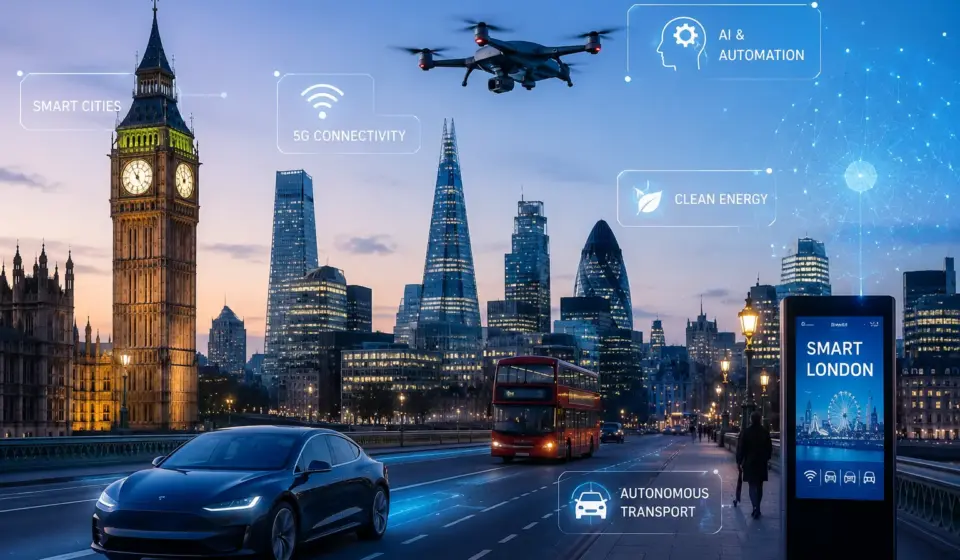

As we have stepped into 2026, we can observe that technological trends are shifting. This continued technological advancement will modernise everything from how organisations work to how consumers interact with the products and services.
Moreover, 2026 brings many advancements that will impact how we live and engage with the world around us. AI-driven transformation will also accelerate this year. From AI, cybersecurity to quantum computing, hyperautomation, the Internet of Things, and blockchain, 2026 technology has vast capabilities to transform various industries and enhance our quality of life.
If you want to know about the technological trends that will dominate in 2026 in the UK, then keep reading this blog.
What technology trends will shape the UK in 2026?
- AI, the core driver of transformation
Some years ago, we considered AI as something part of science fiction. However, AI is now the reality of our daily lives. It is one of the major and obvious technological trends dominating in 2026. Before 2026, AI was limited to experimental projects. However, 2026 marks the era of AI operationalisation.
We can look forward to seeing the development of a personal AI assistant that will streamline our tasks and meet our needs. In addition, customer service will also advance with an AI-powered chatbot offering personalised assistance.
- AI in business and governance
UK businesses are now utilising AI to automate workflows, enhance their decision-making, and personalise customer experience. They don’t consider AI a tool but a foundation for modern infrastructure. The major applications of AI in business include:
- Predictive analytics in finance and retail.
- AI-powered chatbots and virtual substance.
- Intelligent supply chain optimisation.
- Fraud detection systems.
The UK government has launched a £500 million Sovereign AI Unit. It aims to encourage domestic AI startups and infrastructure.
- Agentic AI and autonomous decision-making
Another notable trend of 2026 is the rise of agentic AI. It is the first time that it is becoming integrated into significant organisational processes; some studies suggest that by 2028, 15% of the tasks will be done autonomously.
Moreover, these agents are capable of decision-making and executing actions. Therefore, they can negotiate, purchase goods, plan trips, and manage the business processes. In 2026, the limited integration of agentic AI will change to integration in everyday life, impacting our everyday lives and how we interact. Moreover, it is also capable of handling inventory, claims, and facilitating processes.
- Managing operations without human intervention.
- Analysing complex data sets in real time.
- Adapting to changing environments autonomously.
Furthermore, this transformation is redefining the organisational structures. For example, when small human teams collaborate with AI-driven systems, the organisation can achieve higher productivity.
- Impact on employment
AI can create many opportunities and streamline tasks. However, it is also increasing the concerns related to job displacement.
Moreover, in the UK, this shift involves AI-augmented roles rather than replacement and demand for digital and analytical skills, with the emergence of new professions like AI trainers, etc.
We can say that AI is not taking over other people’s jobs but redefining the nature of work.
- Smart cities and urban transformation
Urban cities in the UK are changing into smart cities. In smart cities, technological advancements elevate the infrastructure, governance, and quality of life.
- IoT-driven urban infrastructure
The Internet of Things is significant in connecting the physical infrastructure with the digital systems. Smart cities integrate:
- Sensor for traffic management
- Smart grid for energy efficiency
- Real-time waste management systems
- Intelligent public transport networks
- Eco-friendly urban frameworks
These innovations will lead to less congested and more decentralised cities (improved urban planning), lower energy consumption, enhanced efficiency, and an elevation in the quality of life.
- Data-driven governance
It involves real-time data collection and analysis through IoT devices. Authorities can use this data to predict urban challenges, optimise resource allocation, and enhance public safety. i.e, air-driven surveillance may help in crime prevention, but they also raise concerns regarding privacy.
- Sustainability and climate goals
Smart cities are a crucial part of the UK’s sustainability agenda. Technological advancements such as smart energy systems, electric mobility, and carbon tracing tools are pushing towards net-zero emissions.
- Fintech and digital financial ecosystems
2026 is observing a rise in smart financial ecosystems. Moreover, the UK takes the lead all across Europe in fintech.
- Blockchain and digital assets
In 2026, we will observe that blockchain applications move beyond financial transactions to supply chain management, healthcare, etc. Also, blockchain improves efficiency and transparency, helps in record keeping, ensures authenticity, and enhances voting system security.
The key developments in the UK related to fintech include smart contracts automating transactions, blockchain-based identity verification, and decentralised finance platforms.
- AI in financial services
AI and biometrics are transforming financial transactions through automation of the payment flows through AI agents that can negotiate the transactions autonomously. It also involves the use of biometrics and direct payments via QR codes to remove intermediaries and fraud risk.
Furthermore, regulators are exploring the impact of AI on financial markets. The aim is to ensure consumer protection and market stability.
- Rise of digital payments
Digital payments are now widespread in the UK. 97% of adults now use digital payment platforms. Such as mobile wallets, contactless payments, and online banking.
- Smart healthcare and digital innovation
The best technological trend we can expect to see in the UK in 2026 is in the healthcare sector. It involves AI-driven diagnostics and treatment, remote monitoring, and telemedicine data integration in the health ecosystem.
- AI-driven diagnostics and treatment
AI is revolutionising the healthcare ecosystem by detecting diseases early through data analysis, helping doctors in diagnosis, and personalising treatment plans.
- Remote monitoring and telemedicine
Smart devices help in real-time patient monitoring, remote consultations, and improved access to healthcare services.
This is beneficial in rural areas and reduces the burden on hospitals.
- Data integration and health care ecosystem
Healthcare systems are now becoming interconnected. It allows for seamless sharing of patient data, improved coordination between the provider, and better patient outcomes.
- Smart manufacturing and industry 4.0
The industrial sector of the UK is adopting Industry 4.0. It integrates the automation, connectivity, and intelligence systems.
- AI and robotics in manufacturing
Another major technological advancement is collaborative robotics. Factories in the UK are increasingly adopting AI-powered robots, automated production lines, and predictive maintenance systems. It involves machines and human work side by side, enhancing organisational productivity.
- The automation of the task allows humans to focus on other crucial tasks.
- It leads to higher efficiency and productivity.
- It leads to cost reduction.
- Teams demand retraining programmes due to automation processes.
- Digital twin and simulation
These are the dynamic and virtual replicas of physical systems that allow companies to simulate processes, predict outcomes, and optimise operations.
- Connected supply chains
The smart supply chain utilises IoT and AI to track goods in real time, reduce sales and enhance transparency.
- Cyber security and digital trust
With technological advancements and the interconnectedness of the world, cybersecurity becomes a critical concern.
- Rising cyber threats
In 2026, we can expect an increase in sophisticated cyberattacks such as fraud, cyberbullying, etc. AI has further contributed to this threat due to deepfakes, automated cyberattacks and data breaches.
Therefore, companies must invest in advanced cybersecurity measures, apply AI-driven threat detection systems, integrate zero-trust security models and so on.
- Zero trust architecture
Organisations are also adopting zero-trust security models, which help in the verification of every user and device, minimise vulnerabilities and increase data protection.
What’s the importance of digital trust?
Trust is crucial for the integration of smart technologies; therefore, organisations must ensure transparency, ethical use of AI, and strong data protection policies. Moreover, you must also seek online cipd assignment help ethically.
- Connectivity: 6G, satellite internet, and beyond:
Connectivity is the foundation of smart technology. The paradigm shift of connectivity involves the integration of 6G technologies.
- Expansion of the 5g and 6g networks
5G leads to faster data speeds, low latency, and real-time applications. This supports innovation like autonomous vehicles, smart cities and remote healthcare.
- Satellite connectivity
Satellite-based internet is expanding connectivity to remote areas. It will lead to digital inclusion and access to services.
- Edge computing
It processes data closer to the sources, aiming to reduce latency and improve efficiency.
- Quantum computing
Quantum computing is an emerging smart technology that uses quantum physics to solve problems that are beyond the reach of traditional computers. They use qubits that can represent both 0 and 1 at the same time, which allows them to process vast amounts of data simultaneously. In 2026, we can expect this technology to be applied in health and medicine.
- It could transform machine learning.
- It gives accurate results.
- Smart retail and consumer technology
Another emerging smart technology trend is the smart retail shown by consumer behavior.
- E-commerce and omnichannel retail:
In the UK, online shopping is growing, and a large number of consumers are using digital transactions. Moreover, retailers are adopting AI-driven recommendation systems. Virtual shopping experiences and seamless online and offline integration.
In addition, smart assistants like Alexa are becoming a major part of daily life.
How to integrate human touch in a tech-driven world?
1. Critical thinking skills of humans: technology can never be a replacement for human judgment. Therefore, in this tech-driven world, you must not rely completely on technology and develop your critical thinking skills.
2. Human interaction: technology can never be a replacement for face-to-face human interaction.
3. Creativity: With such smart technological advancement, humans must not stop working on their ideas and innovations. If you lack creativity and are unable to craft original CIPD assignments, seek the best CIPD assignment experts in the UK.
5. Ethical use: smart technology must be utilised ethically; moreover, there must be clear policies regarding its use.
Final thoughts
Smart technology trends 2026 in the UK is not merely about transformation but revolution. With the integration of the AI blockchain, computing, IoT, and other advanced technologies, the UK is becoming a developed and interconnected society.
Moreover, the transformation in the UK is leading to higher efficiency, economic growth, and a better quality of life. You must balance this innovation with responsibility so that smart technology serves as a tool for sustainable development.
Remember that the future is associated with people who can adapt to these new realities and embrace change while remaining ethical.