
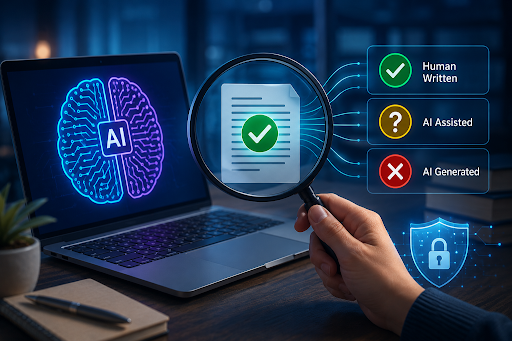

Artificial intelligence has changed the way people create, edit, and publish digital content. From drafting articles to summarizing information, modern AI systems can produce written material within seconds. As the use of these tools has expanded, another category of technology has become increasingly relevant: systems designed to analyze whether text may have been generated or heavily influenced by artificial intelligence.
This is where a Detector IA can become useful. Rather than treating AI detection as a simple yes-or-no process, it is better understood as a form of textual analysis. These systems examine writing patterns and estimate whether certain characteristics resemble machine-generated content. For students, publishers, educators, businesses, and website owners, understanding how such tools work can help them make more informed decisions about digital content.
What Is a Detector IA?
A Detector IA is a tool designed to assess written material for characteristics commonly associated with AI-generated text.
Unlike traditional plagiarism software, an AI detector is not primarily looking for identical sentences copied from another source. Instead, it may analyze characteristics such as sentence construction, word selection, predictability, repetition, consistency, and overall writing patterns.
The purpose is generally to provide an indication of whether content appears human-written, AI-generated, or potentially produced through a combination of both.
However, an important distinction should be made: an AI detection result is an assessment, not absolute proof. Human writing can sometimes resemble machine-generated text, while AI-assisted writing can contain enough variation to appear more natural.
How AI Detection Differs From Plagiarism Checking
AI detection and plagiarism checking are often confused, but they solve different problems.
A plagiarism checker primarily compares submitted content with existing material. It may identify matching phrases, duplicated passages, or similarities between documents and indexed online sources.
An AI detector approaches the problem differently. It evaluates linguistic patterns rather than simply searching for matching text.
For example, an original article written by a person may have no copied sentences at all, yet an AI detector could still identify patterns that resemble automated writing. Conversely, AI-generated text may be substantially edited by a person and become difficult for a detector to classify confidently.
Using both types of analysis can therefore provide a broader picture of content originality and authorship signals.
What Does an AI Detector Analyze?
Different detection systems use different methodologies, but several characteristics can contribute to an assessment.
Predictability of Language
Machine-generated writing can sometimes use highly predictable word sequences. Detection systems may examine how likely certain words are to appear after others.
Sentence Patterns
AI-generated content may demonstrate repeated sentence structures or unusually consistent phrasing. A detector can analyze these patterns across a larger passage.
Vocabulary Distribution
The way words are selected and distributed can also provide signals. Some automated writing may rely heavily on common vocabulary or maintain a remarkably consistent tone throughout a document.
Structural Consistency
Human writers naturally vary their sentence lengths, transitions, emphasis, and phrasing. Automated content can sometimes appear more uniform, although advanced AI systems can produce much more varied writing than earlier models.
These signals are typically combined rather than treated individually.
Why AI Detection Is Becoming Important
The growth of generative AI has created new questions about authorship and originality.
Educational institutions may want to understand whether assignments reflect a student’s own work. Publishers may want greater confidence in the origin of submitted articles. Businesses may need to review large volumes of AI-assisted marketing material. Website owners may also want content that demonstrates genuine expertise rather than repetitive automated production.
A KI Detector can provide an additional review layer in these situations.
The technology is especially useful when combined with editorial judgment. Instead of allowing a detection score to make the final decision, organizations can use it as a signal that encourages closer examination.
AI Detection Has Limitations
No responsible discussion of AI detection should ignore its limitations.
AI-generated and human-generated writing can overlap significantly. A person who writes in a highly formal, repetitive, or predictable style may receive a result suggesting AI involvement. Similarly, content that has been substantially rewritten may produce a different result from the original material.
Factors such as text length, subject matter, language, editing, and writing style can also affect detection performance.
This means a detector should not automatically be treated as an authoritative judge of authorship. A score is better understood as evidence that needs context.
Why Original Writing Still Matters
The rise of AI detection does not change the importance of producing useful content.
Whether content is written manually or created with assistance from AI, readers still expect accuracy, relevance, clarity, and genuine value. Search engines and audiences have little reason to appreciate pages that merely repeat generic information found elsewhere.
Originality should therefore involve more than changing a few words. Strong content can introduce a distinct perspective, organize information differently, provide practical examples, explain difficult concepts clearly, and address questions that competing pages overlook.
A detector can evaluate certain textual signals, but it cannot replace the creative and analytical decisions involved in producing genuinely valuable material.
Using AI Responsibly in Content Creation
AI can be useful during the writing process when it supports rather than replaces human judgment.
For example, a writer might use AI to brainstorm topics, identify possible questions, organize an outline, or improve clarity. The writer can then verify information, add original insights, revise the structure, and ensure that the finished article reflects a genuine understanding of the subject.
This approach produces content that is more useful than simply generating large quantities of articles and publishing them without meaningful review.
Human oversight is particularly important for factual subjects. AI-generated information can contain inaccuracies, outdated claims, or unsupported statements, so important details should be independently checked.
How Businesses Can Use AI Detection Tools
Organizations producing content at scale can incorporate AI detection into a broader quality-control process.
Instead of using detection as the only measurement, businesses can combine it with plagiarism checks, factual verification, editorial review, and content-quality assessments.
A useful workflow might involve:
- Reviewing the purpose and audience of the content.
- Checking factual claims.
- Examining originality and source use.
- Reviewing writing quality and readability.
- Using AI detection as an additional signal.
- Having a human editor make the final judgment.
This layered approach is more reliable than depending on one automated score.
What Makes Content Feel Truly Human?
Human writing is not defined simply by grammatical imperfections.
Strong human-centered content usually reflects clear intent. It answers a real question, understands the reader’s situation, and makes deliberate choices about examples, explanations, structure, and emphasis.
Personal expertise can also make a major difference. Someone with direct knowledge of a subject can add observations, comparisons, experiences, and context that generic automated writing may struggle to reproduce convincingly.
This is why content strategy should focus on usefulness first and detection scores second.
The Future of AI Content Verification
As generative AI continues to develop, detection technology will also evolve. The relationship between AI generation and AI detection is likely to remain complicated because improvements on one side can influence the other.
Future verification systems may increasingly combine textual analysis with additional signals, editorial workflows, provenance information, or other forms of content verification.
For publishers and organizations, this means that simply trying to “beat” a detector is unlikely to be a sustainable content strategy. Building trustworthy, well-researched, genuinely useful material is a stronger long-term approach.
Final Thoughts
A Detector IA can be a valuable part of modern content verification, particularly as AI-generated writing becomes increasingly common. However, detection results should be interpreted carefully rather than treated as unquestionable proof.
AI detection, plagiarism checking, factual review, and human editing each address different aspects of content quality. When these methods are combined, they can provide a more balanced assessment of digital material.
Ultimately, the goal should not be to create text that merely passes a detector. The better objective is to produce content that is original, accurate, purposeful, and genuinely useful to the people reading it. As AI becomes a normal part of digital publishing, those qualities will remain more important than any single detection score.