
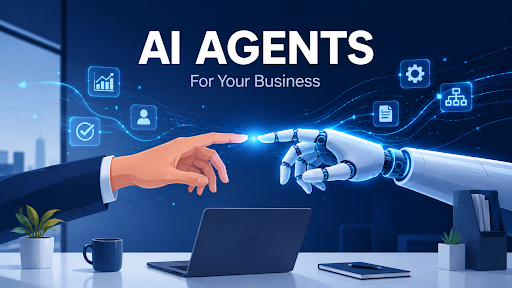

Every second business owner is talking about AI agents right now. Some are already using them. Others are still trying to figure out what the term even means. If you fall into the second group, you’re not behind, you’re just early enough to make smart decisions instead of rushed ones.
Here’s what you actually need to know before you bring an AI agent into your business.
So What Is an AI Agent, Exactly?
Let’s clear this up first, because most explanations online make it more complicated than it needs to be.
An AI agent is software that can look at a situation, decide what to do about it, take that action, and then check whether it worked. No human has to walk it through every single step. That’s really the whole idea.
Compare that to a regular chatbot. A chatbot answers your question and stops. It’s reactive. An AI agent doesn’t stop. It keeps working through a task until it’s done, pulling information from your systems and making calls along the way.
A simple way to think about it: a chatbot is like an assistant who only speaks when spoken to. An AI agent is closer to an employee you trust to handle a task from start to finish, while you check in occasionally.
Read more:AI Readiness Checklist: What Every Organization Must Know Before Scaling AI
Chatbots and AI Agents Aren’t the Same Thing
This mix-up trips people up constantly, and honestly, it’s understandable. The tools look similar on the surface.
But here’s the real difference. Ask a chatbot about an order and it’ll tell you the status. That’s it. Ask an AI agent about that same order, and it can check the status, notice there’s a delay, issue a refund based on your policy, and update the customer’s file, all without anyone lifting a finger. That’s a big jump in what the technology can actually do, and it’s worth understanding before you decide where to use it.
Where Companies Are Already Putting AI Agents to Work
You don’t have to guess where these tools fit. Plenty of businesses have already figured that part out.
Customer support is probably the most common starting point. Agents sort tickets, answer routine questions, and close out simple cases so human reps can deal with the messy ones.
HR teams use them too, mostly for resume screening, interview scheduling, and answering the same benefits questions employees ask over and over.
On the finance side, agents keep an eye on reports, flag anything that looks off, and keep audit trails updated without someone manually checking every entry.
IT and security teams have started leaning on them as well, watching for unusual activity and cutting off access automatically when something doesn’t match the approved list.
And sales teams use them for lead research, so reps aren’t wasting hours chasing people who were never going to buy anyway.
None of this is theoretical. These are the areas where companies are seeing real time saved and real money saved, right now.
Why Should You Even Care?
The short answer: repetitive, rule-based work is exactly what AI agents are good at. Handing that off frees your team to spend time on the stuff that actually needs a human, like judgment calls, tricky conversations, and long-term strategy.
Businesses using agents are reporting quicker response times and lower day-to-day costs. But there’s a quieter shift happening too. Your team stops doing the task themselves and starts supervising the outcome instead. That’s a different way of working, and it takes some getting used to.
Before You Jump In, Think Through These
This is the part most businesses skip, and it’s usually where things go wrong.
Not everything is worth automating. AI agents do best with structured, predictable tasks. Basic customer support, internal ops, simple research, these are safe starting points. Anything involving real judgment or sensitive customer relationships still needs a human at the wheel.
Decide whether to buy or build. Off-the-shelf tools are cheap and quick to set up, usually a small monthly fee per user. Custom-built agents cost a lot more, sometimes hundreds of thousands of dollars, and only make sense if your workflow is genuinely unique to your business. For most small and mid-sized companies, buying is the smarter first step.
Get your data in order first. An AI agent can only work with what it can see. If your customer records or inventory data are scattered across five different tools that don’t talk to each other, the agent is going to struggle no matter how good it is.
Keep a human in the loop. Even the best agents make mistakes, especially early on. Decide upfront what the agent can do on its own and what needs a person to sign off. It’ll save you headaches later.
Start small. Don’t roll this out across your whole business on day one. Pick one task, run it as a pilot, see what actually happens, then decide whether to expand.
A Simple Way to Get Started
If you’re ready to try it, keep it simple:
- Pick one repetitive task that’s eating up your team’s time.
- Find an off-the-shelf AI agent built for that specific job.
- Connect it to clean, organized data.
- Set clear rules for when a human needs to step in.
- Run it as a test, measure what happens, then decide what’s next.
Nothing fancy. Just a low-risk way to learn what works for your business specifically.
AI-powered invoice management simplifies accounts payable, reduces errors, etc.
Frequently Asked Questions
Is an AI agent basically the same thing as ChatGPT? Not quite. ChatGPT and tools like it respond to prompts and generate text. An AI agent goes further, it can take action across your actual business systems, not just talk about it.
What does it cost to use AI agents as a small business? Off-the-shelf options are usually affordable, often a small fee per user each month. Custom builds cost far more and are typically only worth it for large or very specific needs.
Do I need to be technical to use one? Not really. Most platforms today are built for people without a tech background. That said, having someone who understands your workflows and data will make setup a lot smoother.
What’s the biggest mistake businesses make with AI agents? Using one for a task that actually needs human judgment, like a sensitive customer situation or a major decision. Stick to structured, low-risk tasks when you’re starting out.
Which teams benefit the most from AI agents right now? Customer support, HR, finance, and IT security are seeing the biggest results this year. These are high-volume, rule-based areas, exactly where AI agents shine.
Final Word
AI agents aren’t magic, and they’re not going anywhere either. The businesses getting real value from them aren’t the ones that moved fastest, they’re the ones that picked the right task, cleaned up their data, kept a human checking the work, and started small. Do that, and there’s a good chance this becomes one of the more useful tools your business has picked up in years.