

Derek had three restaurants doing solid weekend business, and for a while, the delivery apps felt like free money. Someone orders dinner through a third-party platform, the kitchen fires it, a driver picks it up, and the money shows up in his account minus a cut. It took about a year of watching that cut for him to actually sit down and calculate what “a cut” meant. Between the standard 15% to 30% commission and the processing fees, promotions, and refunds layered on top, his real cost per delivery order was closer to 35% of the ticket, on food that already ran thin margins before anyone took a percentage off the top.
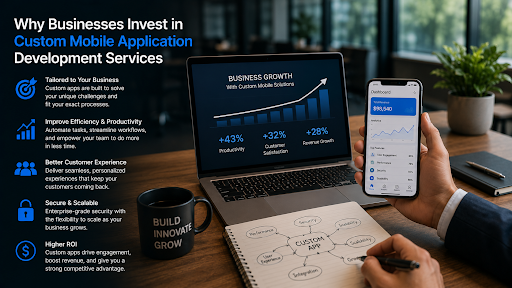
That math is exactly why demand for custom mobile application development services has grown steadily even as free and low-cost app builders have gotten better, because the businesses hitting this wall aren’t looking for an app, they’re looking for an exit from paying rent on their own customer base. Derek didn’t need convincing that an app could help him. He needed to understand why building his own would do something a $30-a-month template never could.
The Cost of Renting Someone Else’s Platform
Every off-the-shelf platform, whether it’s a delivery marketplace, a booking tool, or a generic e-commerce template, makes money by sitting between a business and its customers. That’s the entire model, and it works fine right up until the volume gets real. A restaurant doing modest weekend delivery volume can lose tens of thousands of dollars a year to commissions on orders from customers who already know exactly who they are and would have ordered directly if there’d been an easy way to. Direct, owned ordering channels typically keep the vast majority of each transaction; marketplace orders routinely hand over a quarter to a third of it before anyone accounts for food or labor. The fee isn’t the real cost. The real cost is that it scales with your success instead of shrinking as you grow, which is the opposite of how a cost structure should behave.
Who Actually Owns the Customer
Here’s the part that took Derek longer to see than the commission math. When someone orders through a third-party app, the platform holds the contact information, the order history, and the relationship. Derek couldn’t email a regular who hadn’t ordered in three weeks, because he didn’t have her email. He couldn’t run a loyalty program based on actual order patterns, because he couldn’t see the patterns. The app fulfilled the food and the platform kept the customer. A custom-built ordering app routes that same order through infrastructure Derek actually owns, which means every repeat customer becomes data he can act on instead of a transaction he can’t trace.
Where Off-the-Shelf Tools Hit a Wall
This pattern shows up well outside restaurants. A clinic using a generic scheduling app can’t customize intake questions around its own specialty. A field service company dispatching technicians through a templated tool can’t route jobs the way its dispatchers actually think. A retailer on a marketplace app can’t sync inventory with the point-of-sale system it already paid for. Off-the-shelf software is built to serve thousands of businesses at once, so it optimizes for the features most businesses need in common, not the specific workflow that makes any one business actually run. There’s a growth ceiling built into that same convenience, too. A templated app that felt flexible enough at fifty customers starts showing its seams at five thousand, and by then the business has usually built months of manual workarounds for gaps the software was never going to close on its own. Custom development flips that: instead of the business adapting to the software, the software gets built around how the business already operates.
The Trade-off Nobody Skips
None of this means custom is automatically the right call, and skipping this part is how agencies oversell it. A custom build costs more upfront than a subscription to an existing tool, takes longer to launch, and needs a discovery phase where a development team actually learns the business before writing code. For a brand-new restaurant still figuring out its menu, or a startup that hasn’t validated whether people want the product yet, an off-the-shelf tool is the right call, not a lesser one. The honest answer to why invest in custom mobile application development almost never starts with wanting the newest technology. It starts with being far enough along that renting a generic platform is now costing more than owning one would.
What Changes Once You Own the Platform
Once Derek’s team launched their own ordering app, integrated directly with the point-of-sale system already running in all three locations, the difference wasn’t just the commission he stopped paying. It was that the roadmap was his. No policy change from a platform he didn’t control could suddenly bury his restaurants in search results or change the fee structure overnight. No algorithm update could decide his food photos needed to look like everyone else’s. He could add a loyalty feature the week he thought of it instead of waiting for a platform to build it for every restaurant on their app at once. That’s the part that doesn’t show up in a commission calculation: control over the thing that’s supposed to be yours in the first place. The upfront cost is real, and it’s higher than signing up for another subscription. But a subscription is a cost that repeats every single month with no ceiling on it, while a custom build is a cost that’s front-loaded and then mostly just needs upkeep, and that’s a very different curve once you look at it over five years instead of five months.