
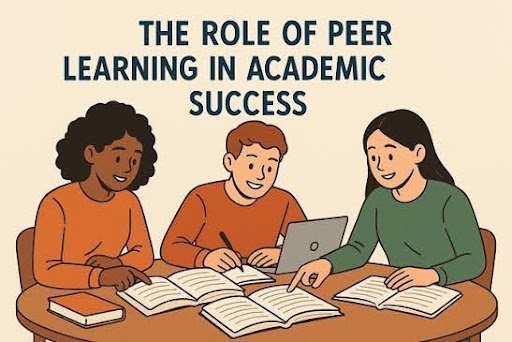

While it is usually seen as an individual experience, the best learning sometimes happens when the candidates prepare for the exams among other like-minded people. Although experienced professors, good material, and mock tests play key roles in a quality coaching class for bank exams, learning through interaction with peers plays an essential role as well. Studying in such an atmosphere not only helps the candidates learn better but also motivates them. Being able to share ideas, solve tasks together, and discuss complicated things is what will make their preparation process easier and more interesting. The environment in which the candidates help each other not only enhances their knowledge but also builds self-confidence and communication skills, and helps them be consistent with their preparation.
Peer learning is important for the overall experience of Bank coaching as it promotes teamwork, problem-solving abilities, and confidence due to knowledge and experience sharing.
The value of peer learning in bank coaching institutes
Read the following pointers to learn about the value of peer learning in bank coaching institutes:
Encourages collaborative learning
The most important aspect of attending coaching classes is that you get the opportunity to study with people having the same objective. In the classroom and through activities such as group discussion, problem solving, etc., you come across various methods to solve questions. At times, a tough concept may become easy to understand by listening to your classmates.
Improves conceptual understanding
Every student has their own abilities and style of learning. While some may have a good ability in mathematics, others may be able in reasoning or even English. Through interaction with fellow students, the candidates will be able to pick up tips and tricks for solving problems.
Creates a healthy competitive environment
A coaching institute is an organization that creates an environment where students with common aspirations join together, and hence, healthy competition arises among them. The hard work of other students performing well in projects or practice examinations serves as an encouragement for students to perform better themselves.
Helps solve doubts more efficiently
Students always have doubts while working on practice problems post-class. Even though teachers are always there to assist, discussing these doubts with fellow students will give immediate solutions along with a different perspective. Group discussion ensures that students actively learn more than one way to solve a problem.
Enhances communication skills
Peer learning is characterized by frequent discussions, presentations, and sharing of thoughts and ideas, thus enhancing one’s communication skills. For one to effectively explain an idea to others, they must have clear thinking and, hence, understand things better themselves. Good communication skills will come in handy, especially when going through a recruitment process.
Increases motivation and consistency
Banking exam preparation may at times prove to be mentally draining, particularly when there is continuous studying. Studying with peers who are equally determined provides a motivating environment that enables them to inspire each other to stay focused and consistent.
Encourages knowledge sharing
All candidates make use of various sources of information in their preparation process, like shortcuts, methods of improving vocabulary, news, and other sources of information. Through peer learning, the candidates will have a chance to exchange these important sources of information, meaning that everyone will benefit from each other.
Improves performance in mock tests
Several coaching institutions have practices of discussing the answers to their mock tests with students after finishing those tests are completed. By doing this, they can find out their weak points as well as get acquainted with various methods of solving problems. Through experience sharing, future performance on mock tests will be improved.
Builds confidence
Most beginners suffer from self-doubt during the period of preparation. Constant interaction with peers makes the students understand that all of us have some hurdles when it comes to preparing for the exams. Discussion and collaboration with each other increase the confidence of the students.
Develops teamwork and leadership skills
Even though banking examinations are conducted individually, working together is an essential aspect of any profession. Studying in groups makes the students learn about collaborating and managing the discussion. At times, leading the discussion can make the student a good leader and prove useful during interviews and later on as a banker.
Makes learning more enjoyable
Learning all alone for extended periods of time can prove to be rather tedious. Collaborative learning brings a sense of variety to the entire preparation process through debates, tests, joint rehearsals, and joint revisions. The interactive mode of learning helps keep the learner motivated.
Peer learning is an essential component of the SSC coaching center that helps aspirants learn from each other’s strengths and become more confident throughout their preparation process.
Conclusion
Learning among peers may be considered one of the most beneficial, but at the same time, most underrated advantages of being part of a bank coaching institute. Interaction among peers brings about chances for cooperation, competition, sharing of information, and constant motivation. Peer learning helps build concepts better, enhances communication skills, instills confidence, and motivates the students throughout the preparation process. With the help of good faculty members, quality coaching, constant practice through mock tests, and self-study, the process of examination preparation becomes much more fruitful. In helping each other in realizing their own personal goals, aspirants of the banking sector can make the most of themselves.